· To enlarge a photo you can right click on the photo and use the ''More Tools'' and then the ''magnify image'' functions.....or use the built-in browser features or tools of your computer.
CA-302 Ferme à Bizy
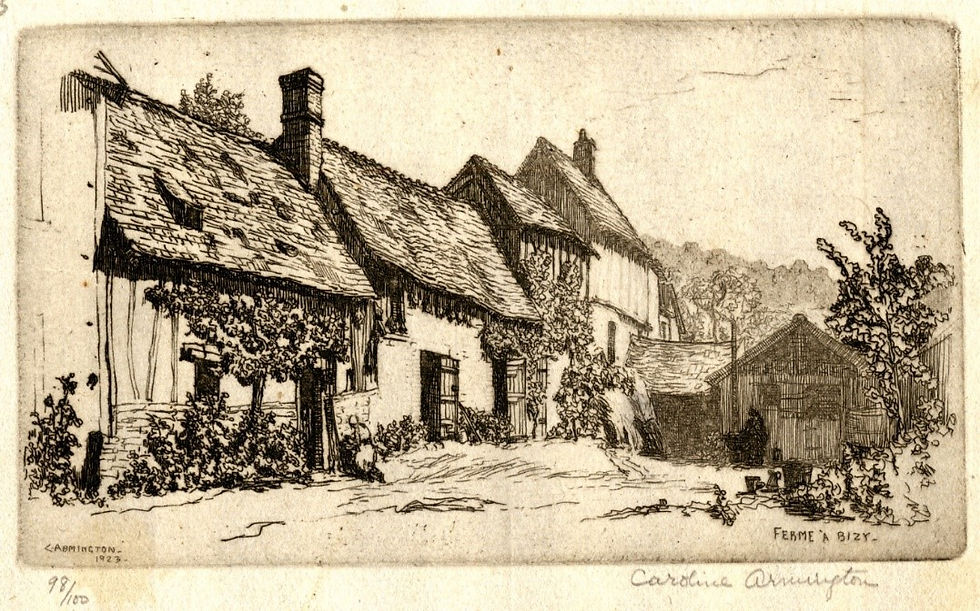
Title in Caroline Armington’s etching record book: Ferme à Bizy
Year: 1923
Number: 302
Size: 8.3 × 15.6 cm
States: 2
Title on Print: Ferme à Bizy
Initials or Signature and Date in Plate:
Planned Edition: 100
Total Number of Impressions: 111
Number in Pencil:
One dedicated to ‘’ To The Des Moines Association of Fine Arts’’ not numbered
No 16/100 dedicated ‘’To Mrs. j. a. xxxxx; Friendly souvenir from c.a.; New York, April 1924’’
79, 80, 84, 89, 93, 98/100
Signature in Pencil: Caroline Armington
Dedication:
‘’To The Des Moines Association of Fine Arts’’
‘’to Mrs j. a. xxxxx; Friendly souvenir from c.a.; New York, April 1924’’
Caroline Armington’s etching record book contains the following notes for this print:
1st state 1
2nd, 1 for Frank
1 special print for Mr. & Mrs. Risley, not numbered
Mrs. Ovington, not munbered
1 print for the Des Moines Association of Fine Arts, Iowa
Epreuves d’essai 1/6 to 6/6
No 1 to 100
Plate crossed, 1 print
1932
Price in Caroline Armington’s etching record book: none.
Plate: plate was crossed in 1932.
Collections:
McGill University, McGill Library, Rare Books & Special Collections
PAMA
Des Moines Art Center
Exhibitions:
Publications:
Fine Prints of the Year 1924 Volume 2
Comments:
Caroline Armington sold one print of Vernon (CA-296) and one of each of her six prints of Bizy (CA-297 to CA-302) to Mrs. Ovington.
Mrs. Ovington was most probably Mary White Ovington.
Born 11 Apr 1865 in Brooklyn, Kings, New York, United States.
Died 15 Jul 1951 at age 86 in Newton Highlands, Newton, Middlesex, Massachusetts, United States.
She was an American socialist, suffragist, journalist, and co-founder of the National Association for the Advancement of Colored People.
She was born into a wealthy abolitionist family. Her parents, members of the Unitarian Church were supporters of women's rights and had been involved in anti-slavery movement.
Mary White Ovington’s father, Theodore Tweedy Ovington, built a substantial fortune as an upscale merchant.
Around 1923, the Ovington company—famously known as "The Gift Shop of Fifth Avenue"—was experiencing a massive commercial resurgence and operating at the absolute peak of its 20th-century prestige. This multi-floor Midtown Manhattan location was operating as a premier destination for New York’s elite. By 1923, the thriving company was successfully managed by the next generation of the family, including Charles K. Ovington.

‘’ To The Des Moines Association of Fine Arts’’ Not numbered
Numbered 98/100
